Other views on the subject:Participants get on with the game
By Campbell Burnes
The Herald spoke to five rugby people on what the changes might mean for the game in 2017.
Those immersed in professional rugby are mostly just getting on with it, seeking ways to adapt to the new landscape.
These laws will not be changing. They are enshrined, which is within World Rugby's remit on player welfare.
But there are sceptics and there will be teething issues, as evidenced by last weekend's play in Europe, where there is often a chasm between fact and interpretation when differentiating on a reckless or accidental tackle.
Chris Boyd (Hurricanes coach)
"We agree 100 per cent that safety is paramount in the game. With the increase in medical science and understanding the consequences of contact to the head, we are supportive of that. I think there are going to be interesting interpretations of how that might look, particularly when you get very close to the line, and guys are driving low.
It's going to be interesting, but we just have to adjust to whatever the ruling, just like we did with the trial [laws] in the Mitre 10 Cup."
Rod Hill (NZ Rugby referees boss)
"It's not going to be easy to get it right through all the grades, but we want mums and dads to have their kids playing the game. If we work together, we'll achieve the goal. If we push against it, then you are looking at the game from the wrong perspective. Our challenge as refs is to achieve consistency across the group.
There is a judgmental element as to what is a reckless tackle and what is an accidental tackle. That will make the refs' jobs a bit tougher but at the end of the day, a swinging arm to the jaw equals a red card."
"It's a positive change. We've had the recognise, remove, recover and diagnose type scenario. This is the next phase, an injury prevention strategy. Studies out of the UK show most concussions occur out of the tackle situation, about 30 per cent being the person tackled, and the rest the tackler. Now you can't take the tackle out of the game. That's not what we want to do. But by lowering the tackle, it might just reduce the risk to the person being tackled. It's a tough sport and the contact has ramped up. It's very much a defence-oriented game. This is positive without changing the nature of the game."
Allan Pollock (North Harbour sevens coach)
"I have always been a big fan of training my defence to tackle below the ball. Part of being in a good position to make a tackle is lowering your shoulders and you must leave your feet. If you do all that, you won't have these standing tackles where you are getting shoulder on chin. It does come back to coaching. We have coached a generation to 'big bang' on tackles. That was not the way 20 years ago. Coaching has brought us to that point, and coaching has brought us away from that point."
Isa Nacewa (Leinster outside back)
"We haven't trained any differently. To us, the laws around head-high tackles haven't changed to what was in place around the 2015 World Cup, more so just how it is enforced. What has changed is the awareness of it has been heightened. And how the referee sees it and enforces it. We have just focused on getting on with it."
Offloaders should enjoy law change
By Campbell Burnes
The master of the off-load Sonny Bill Williams sends Ma'a Nonu on his way. The high tackle rules could see the All Blacks, who are masters at off-loading, run riot. Photo / Brett Phibbs
Trouble is brewing for the national sport. Most clear-headed rugby people would agree, from a medical and player welfare point of view, that the new high tackle law changes are positive for the game, but from a rugby standpoint, there are cans of worms creaking open.
One of the largest is the fact that referees, already under strain, have been handed a hospital pass with a ball encased in grey areas. It's clear players must lower their tackling, after years of the tackle height creeping up, but match officials now have to determine intent and have more powers to use red or yellow cards. In TV games, they will head straight to the TMO if in doubt.
Most grades of the game do not have that option, so referees may end up guessing, being over-zealous or relying on unreliable testimony from unqualified assistant referees.
How will this affect the All Blacks and other New Zealand rugby sides?
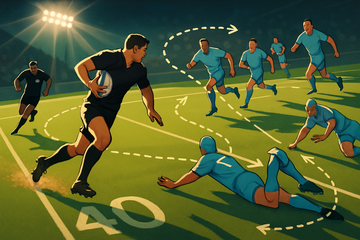
On the face of it, it will surely mean the likes of Sonny Bill Williams and Kieran Read, on the fringes, will run riot with their offloading games.
Former All Black Richard Turner, who has a first-hand TV view of the new law changes at this weekend's national sevens event in Rotorua, attempted some crystal ball-gazing.
"Our strength in New Zealand rugby is to offload and play the ball in hand game from 1-15. If there is adjustment to the tackle technique, it will benefit the New Zealand style," says Turner, who is among the sceptics about how the changes will be implemented.
But while sides may be nervous that World Rugby have handed the All Blacks a further advantage, things may not be that clearcut.
North Harbour sevens coach Allan Pollock says coaches should not worry too much about stopping offloads but focus on chop (low) tackles.
"My answer is don't stop offloads. You deal with it when it happens. Not everyone is Sonny Bill Williams. If they want to indulge in high risk play like, then reap the rewards," says Pollock, who anticipates few issues at the sevens in Rotorua this weekend.
After all, though increasingly physical at the top end, sevens is not built around defence. The onus, he argues, will be on the next defender shutting down, via a chop tackle, the offload to the next attacking player.
Most Super Rugby franchises were unwilling, when approached by the Herald this week, to speculate on what their game might look like when the 2017 competition kicks off in six weeks. Most are assiduously honing techniques to fit what is coming.
New Zealand Rugby high performance referees manager Rod Hill says there will be full briefing for franchises and referees before the February 23 kickoff, and the pre-season will be instructive.
Hill does not believe things will get out of hand, with cards being dished out arbitrarily, at least until after an initial settling in period.
"If a ball carrier slips [and is tackled high accidentally], we're not going to have red cards for those sort of things. We want to be practical about how we apply things. We're not sending guys out there to marshal traffic on the corner.
"We want to work closely with teams to make sure we get it right and fair," Hill says.
Turner has questions, as do many, around areas like TV games stretching to almost two hours, judging a tackle on a player driving close to the line to score, and on the growing burden on referees.
"The intent is correct but you are just introducing more subjectivity to the laws of the game and that's the problem," he says.
There was controversy in the first week in Europe. Do not expect much difference in the first week of Super Rugby. But, regardless, the tackles will have to come down.
- NZ Herald