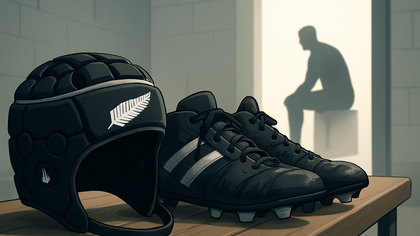
Since the onset of the international season, the All Blacks have experienced numerous player injuries, prompting Rennie to frequently adjust his lineup. Among those sidelined are key figures Ardie Savea and Ruben Love, who are ruled out for the upcoming end-of-year tour. Uncertainty also surrounds the participation of Richie Mo’unga in the Nations Championship.
Further complicating the team's preparations for their northern tour, Leroy Carter has been confirmed as unavailable. The full impact of these absences will become clearer when the squad for the matches against Wales, Scotland, and England is announced.
"Seventeen is a heck of a lot isn’t it? But on one side of it, it’s promising because we’ve got depth," Muliaina remarked on The Breakdown. "It’s the time now to really test your depth and Dave Rennie’s done that. He’s already started implementing that, he’s forced to do it ever more. Have we got the stock? From what I see, we do."
In the face of these challenges, Muliaina praised the resilience and capability of the newer players stepping into the breach. He suggested that the necessity to adapt might be revealing an underappreciated depth within the team's ranks, potentially turning a predicament into an opportunity for growth and development.
Joining the discussion, ex-All Black Brad Weber expressed particular concern over the back-row, where replacements for the potent Savea-Luke Jacobson duo were crucial. He highlighted the performances of Peter Lakai and Wallace Sititi, who excelled in recent tests, indicating that the team's strength remains robust despite the reshuffles.
"You look at those players, particularly Love, Savea, Jacobson, those are big names. The replacement players you’re bringing in, how big a drop-off is it? It’s not a big drop-off from Ruben Love is it? We’ve got great 10s," said Weber. "Coming back from an injury and then he had that bad concussion in the back-end of Super Rugby, he didn’t look like himself for the first couple of games back in the All Blacks jersey, but on the weekend, man, it looks like he’s back to his devastating best."
Weber’s insights underscore the notion that while the initial impact of injuries can be disconcerting, they also force teams to tap into their full potential and resilience. The emerging players have not only filled the gaps but have also added fresh dynamics to the team, suggesting that New Zealand’s rugby depth might be even richer than previously thought.
The All Blacks' upcoming tours will undoubtedly be a litmus test for this newfound depth, and the results could define Rennie’s tenure as a period of unexpected growth spurred by unforeseen challenges.
Muliaina and Weber’s commentary not only puts a spotlight on the immediate effects of the injury crisis but also prompts broader reflections on how adversities can be converted into opportunities for development and discovery in the high-stakes world of international rugby.