At the risk of becoming as predictable as Springbok rugby I am going to have a last shot at discussing their inability to adapt.
Even though this subject may have been ridden into the ground, the fact is that South African rugby still relies on physicality to win games.
The sad reality is that teams have become so much smarter in defence and at slowing down attacking ball.
The major cause for this is the manner in which South Africa attack. The breakdown struggles are just one of the resultant symptoms. The aggressive rush defence and subsequent offensive defence of the contact zone has evolved and changed the nature of how teams must approach the gain line on attack.
There are various ways of how the opposition defends in modern day rugby, the most common way is to rush the line and have the outside centre shoot the line to cut off the outside ball. The double tackle is used to stop the ball carrier from gaining the advantage line or continuing the momentum of the attacking team.
The low tackle is well exploited by the tackle assist ready and prone to acquire possession immediately after the tackle is made and the arriving players can secure the ball. The imaginary gate from which arriving players must enter has now become the pillar from which the round house kick is used to spoil accurate clean up by the half backs.
The drive over the ruck, with a collective flop onto the ground secures the ball and immediately closes access to the ball for the attacking team, and the sly tackle, not really releasing while getting to your feet, then refraining the tackled player from placing the ball another well executed manner of spoiling attacking ball.
My all-time favourite is the lean over the prone player using him as a ‘prop’ for not falling over and having at the ball like a hungry mongrel which fools many referees.
There is of course also the ‘if we all infringe at the same time it looks legal’ defence of the ruck, where everyone, the dog and the kitchen sink is thrown at the ruck. The referee interprets it as a counter ruck not being contested, and then when the whole pack falls over to seal the ball the damage has been done and referee calls play on.
There is of course the tackle turned into a maul by holding the tackled player up and surrounding him with as many defenders as possible in order to win the turn over. You may also find the odd sneaky ‘slap the ball out of the halfback’s hand’, which is increasingly difficult to spot these days.
The maul is defended by not engaging it, and the new trick is to send a defender around the ‘non maul’ to nail the ball carrier and win the turnover. The sacking of the maul is of course the best method to avoid having to defend the maul before it has formed.
There is the ever popular ‘swim through the maul’, which more often than not is just a swim around the side of the maul disguised as ‘through the maul’.
When looking at the above tactics it is clear that defence has evolved dramatically over the past few years and attacking with brawn is only going to be successful against teams well short in the physical stakes.
So how does one adapt to the new age defence?
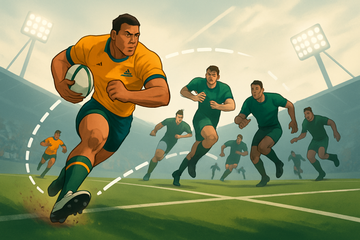
The most exciting attack in my view is to use turnover ball in counter attack, the opposition team is not set up for defence, they are not organised and there is plenty of space out wide. It is, however, imperative to get the ball wide immediately. The first receiver must get the ball to players in space, it is also imperative to get the ball to speedsters. Having a prop running counter attack ball is useless, as they will be shut down by cover defenders and the advantage of space will be lost.
Avoid the contact areas as much as possible, avoid the traffic as much as possible, it is better to hit contact where the opposition has less forwards as they will take time to get to the ruck. However, in this case it is imperative not to get isolated, so running away from your support runners is an absolute no-no, there is no benefit in gaining forty yards and being turned over.
Support runners on either shoulder is an absolute must to employ the offload, and if the offload is not possible the support runners will be able to secure quick ball.
At the contact zone the first, second and third arrivals must have defined jobs, it doesn’t matter who the first defender is. He must be able to assess the first immediate danger and negate it. Simply going prone over the ball carrier is not enough.
At the moment of the contact on the ball carrier, the first arrival must be able to assess whether cleaning out the tackle assist is a higher priority than being prone over the tackled player. The second arrival needs to be more aware of the position of the first arrival, how often do we see the second arriving player push the first over and thus conceding a penalty for sealing off?
Cleaning a player past the ruck, is not always the best outcome, as you not only take the opposition player out, but yourself as well. If the defending team has a second player in position, you are just clearing the path for him.
Get the opposition defenders at the breakdown off their feet, or alternatively secure their legs, this new trend of having a hack at the ball makes life rather difficult for the halfback.
Johnny Sexton and Aaron Cruden are currently the two most intelligent kickers in world rugby, they can exploit the spaces behind the rush defence and they have the ability to execute the cross kick for the waiting wing more accurately than any other. They use the kick as an attacking weapon, something South Africa and Australia rarely do.
Shifting the point of attack does not rest on the shoulders of the flyhalf only, the midfield plays a big part in how defences set up. Whether it has to do with fooling defensive lines with angled runs, wide runs, staying back, or whatever play the midfield makes, the 12 has to be a playmaker. I concede I am not an expert on attacking ploys, but even for someone who propped up the scrum in his playing days it is clear that crash ball running has limited use.
Crash ball is inevitably a predictable line and often onto the strong shoulder of the defender as he is waiting for the moment of impact and ready for it, changing the angle of attack is about getting a runner onto the weak shoulder of the defender. Straightening the line of attack is as important as support runners coming in on the angle.
Far too often the midfield of South Africa run the outside backs into touch, with no space for them to manoeuvre, but this is often as a result of the support runners not being able to run themselves into the best positions to receive the ball.
Attack is about finding the space where there are no defenders, it is about deceit, running angles, creating space, fooling defenders and putting your support runner into a better position than you are.
After all, what is the use to pass or offload the ball to a player that is going to be worse off than yourself? Ultimately attack is most effective when the opposition is hesitant and the way to do that is to eliminate predictability.
Free flowing attack is about keeping the ball alive for as long as possible for continuous periods of time without having it interfered with by the breakdown battle. The faster and longer you can keep the ball alive, the better your chances of catching the defence off guard.
Heyneke Meyer has a big challenge ahead, Willie le Roux is the only player in the South African backline that understands how to find or create space, be it with a delayed pass, waiting for the support runners, changing the angles of attack or utilising a chip or grubber.
Handre Pollard and Patrick Lambie has shown glimpses of it, Cornal Hendricks is a devastating finisher and Bryan Habana is still one of the best wings in world rugby. But they need to find themselves in a one on one position.
The midfield combination of South Africa, however, relies on physicality and physicality alone, there are no smarts or creativity between Jean de Villiers and Jan Serfontein, nothing.
They are both good players, but as a combination they bring nothing but brawn.
The South African pack brings every component you may require except the skills necessary to play free flowing attacking rugby, and the nous to negate smarter teams at the contact zone.
Heyneke Meyer needs players who are more adept in attack, muscle is not enough. Paul Jordaan is probably the most creative midfielder in South Africa, we need one of him, Nizaam Carr is an explosive attacking back rower with vision and a desire to link with like-minded attacking players.
I am not punting Carr nor Jordaan to Meyer, but I am imploring him to revisit his selections, and find players who are smarter, more attack-minded, and more able to play free flowing rugby.
Hit and run is a criminal offence, and if we continue playing this way, we will pay the price for not changing. How many more times do I have to complain about this?
Oh, and please stop underestimating teams, it will bite you in the arse.