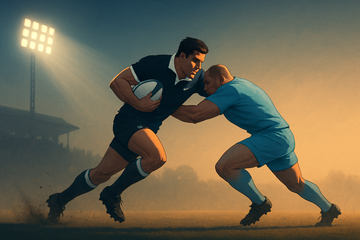
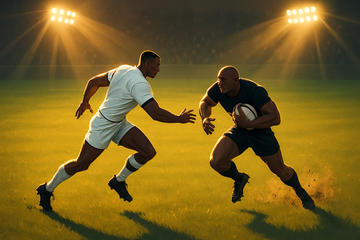
The first rugby contacts between New Zealanders and South Africans was in wartime and sometimes it seems that it is still so - brave young men going into battle, 'putting their bodies on the line'.
It started in the Anglo-Boer War, when nearly 7 000 New Zealand troops came to bolster the Empire's chances of beating the farmers of the Transvaal and the Free State. They formed rugby clubs, called New Zealand, in Pretoria, Ladysmith and Durban.
Bunny Abbott and Dave Gallaher later became All Blacks - Gallaher captained the 1905-06 pioneering All Blacks. Bob Goldstone also came to fight and stayed to teach and the main field at Maritzburg College is Goldstone's.
They met next on the same side in World War I and at the end of the war played in the Imperial Services Tournament. After that horrific war the first New Zealand team came on tour to South Africa - the Imperial Services team on their way home from Europe's battlefields.
And in World War II there was again lots of rugby contact in North Africa, up the leg of Italy and beyond.
When the All Blacks came to South Africa in 1949, the first tour after the war, the great Boy Louw, recently Bombardier Boy Louw of the Sixth Division, had a message for the Springboks: 'When South Africa plays New Zealand, consider your country at war.'
It is a kind of battle in which only brave men take part and it will be so at again at Ellis Park on Saturday, but it is war without hatred and when it is over the combatants are friends again, shaking hands, smiling and looking forward to a beer.
It is a game, after all, a match between opponents, not a battle between enemies, and spoils of war are honour and a sense of satisfaction.
There is a kind of catharsis in treating something essentially trivial as if it were a matter of life and death.
The match between Springbok and All Black remains the greatest, tensest rugby occasion on earth.
Nobody in South Africa and nobody in New Zealand will be indifferent about it, even in this day when it has become such a frequent event.
It will be spoken about and written about, there will be speculation and the match itself will fly by in an agony of tension.
Much of the speculation will aim at reducing the anxiety of the wait - reasons why your side will win are a palliative.
Obviously, either side could win.
After all the Springboks could have won in New Zealand, just three weeks ago.
For New Zealanders fearing the altitude of Johannesburg and the aggressive patriotism of the home crowd will be mindful of the great New Zealand win in 2013.
South Africans will believe that their team in 2014 is stronger and the All Blacks weaker than they were in 2013.
Much will depend on how teams man up - how cohesive they are. Much will depend on taking opportunities. Much will depend on small things that have big consequences. Much will depend on which team can dominate.
For every one of the 44 players it will be a day unforgettable tension.
The All Blacks will want to give the big Springbok forwards the runaround and they can do that best on the firm turf of Ellis Park in wind-free Johannesburg. The playing conditions should suit them perfectly.
It also seems that the All Blacks have picked a powerful bench, in some respects more impressive than their starting side. Clearly they are aware of the power of the Springbok bench that demolished the Wallabies in the last 15 minutes last week.
Players to Watch:
For South Africa: The big wonder you will have is who will start at No.8 for South Africa - massive, imperious but injured Duane Vermeulen or that fearless competitor Schalk Burger. You will hope that Willie le Roux gets his magic back, that Handré Pollard finds again his Wellington form and that earnest Bryan Habana gets a chance to hare away for the line.
For New Zealand: The All Blacks have the more obvious stars, amongst the backs at least. From Israel Dagg to Aaron Smith they are all stars in their positions. Beauden Barrett may be the least obvious of them and yet he too can break a game apart. You will want to watch the gliding skill of Ben Smith on one wing and the Lomu-esque ability of Julian Savea to score tries. And there is the action man, a real handful in the centre, Malakai Fekitoa and the sprightly genius of Aaron Smith at the base of the pack. In the pack you will notice noble Kieran Read and the activities - not always legal - of Richie McCaw.
Head to Head: There is the line-out battle between Victor Matfield and Sam Whitelock, two of the world's best line-out exponents. Much will depend here on how the ball is thrown to them. You will want to see the impact of the two fullbacks on the match - Willie le Roux of South Africa and Israel Dagg of New Zealand. There will be a tough conflict in the centres - Jan Serfontein and Jean de Villiers against sophisticated Conrad Smith and his eager Tongan partner Malakai Fekitoa. There will be the battle at the scrums where the All Blacks destroyed the Wallabies in a way that the Springboks did not manage. And there is the breakdown where the All Blacks have been more adept than the Springboks and is such an important facet of their play - that which produces the profitable surprise of turnovers. Goal-kicking? It's important. There is probably not a lot to choose between Handré Pollard/Pat Lambie and Beauden Barrett/Colin Slade, though the New Zealand pair look to have the edge on dependability. Of course, not getting penalised is important and last week the Springboks were parsimonious indeed, conceding only four penalties in the match, just one in the second half. Tactical kicking? Here New Zealand have a decided edge but maybe the Springboks will continue where they left off last week and limit kicking, preferring to play with ball in hand. Tackling? Both sides have hard, determined defence, though the All Blacks have the greater ability to put a wing in space, which means no missed tackle but a lot of opportunity.
Captain18,570 posts
03 Oct 2014, 15:47
#1
03 Oct 2014, 15:47#1