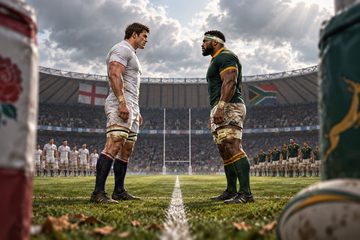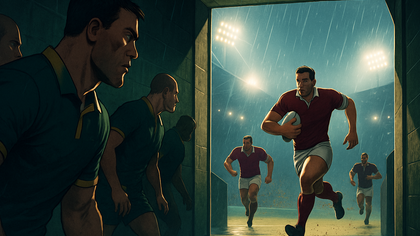
As the whistle blew to kick off the Rugby League World Cup, many Rugby Union fans tuning in might find themselves perplexed by several noticeable differences between their familiar sport and its sibling, Rugby League. Both codes trace their origins back to the same roots, yet they've evolved distinctly over more than a century. Let's delve into these differences and similarities, as the tournament unfurls across Australia, New Zealand, and Papua New Guinea.
The pitch and duration of play in both codes are quite similar; games last 80 minutes and the ball must be passed backwards. However, the team setup and dynamics differ notably. In Rugby Union, each side fields 15 players, while Rugby League teams comprise 13 players. The scrum in Rugby Union is a combative eight-player contest, unlike the more nominal six-player scrums in Rugby League that serve mainly to restart play without contest.
Rugby Union features lineouts and competitive rucks following tackles, which are absent in Rugby League. Instead, Rugby League uses a tap-and-go method to restart play after the ball goes out, and introduces a 'play-the-ball' system post-tackle, where the tackled player restarts play unchallenged. These adaptations contribute to Rugby League’s reputation for faster, continuous play and longer ball-in-play time compared to its Union counterpart.
Field dimensions also vary slightly. Rugby Union pitches can be up to 144 meters long and 70 meters wide, whereas Rugby League pitches are slightly smaller. This affects strategic elements like the 40:20 kick in Rugby League, a play that mirrors Rugby Union’s more recent 50:22 rule, both designed to reward teams for tactical kicking.
Scoring in the two codes shows some divergence too. A try in Rugby Union is worth five points, a conversion adds two, a penalty goal grants three, and a drop goal earns three points. Rugby League, on the other hand, awards four points for a try, two for a conversion, two for a penalty goal, and a single point for a drop goal.
Since 1972, Rugby League has operated under the 'set of six' tackle rule, allowing the attacking team six attempts to score before turning the ball over. This is somewhat akin to the downs system in American football. The sin bin, a penalty resulting in ten minutes out of play for the penalized player, originated in Rugby League in the 1980s and was later adopted by Rugby Union.
Rugby League’s simpler structure, with no flankers and more straightforward positions, contrasts with the highly specialized roles in Rugby Union’s 15-man teams. This streamlined approach in League facilitates a faster, more fluid gameplay style.
"Rugby League offers a more continuous, spectator-friendly experience, often making it appear more dynamic than Union," noted a commentator during the World Cup.
The origin of these two distinct but intertwined codes dates back to disputes over player compensation in 1895 England, leading to the split between what now are Rugby Union and Rugby League. This historical divergence has led to the rich tapestry of rugby that fans around the globe cherish today.
Whether you’re a die-hard Rugby Union fan or a newcomer to Rugby League, understanding these nuances can greatly enhance your appreciation of the sport. As the Rugby League World Cup progresses, keep these differences and similarities in mind to fully enjoy the spectacle.
So, grab your jerseys, pick your favorite spot on the couch, and get ready for a thrilling Rugby League World Cup experience, celebrating both what sets it apart and what it shares with its older sibling, Rugby Union.