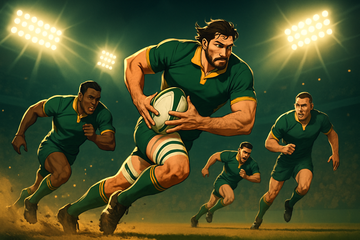
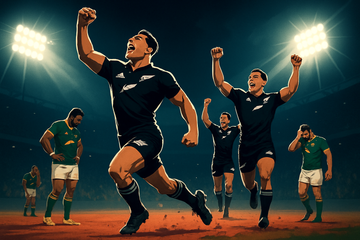
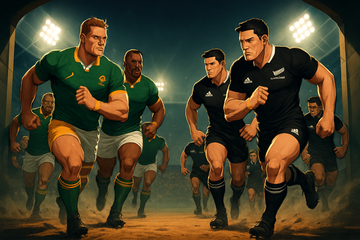
The problem with the arm-wrestling approach was that rugby near to totally lost the appeal if had from a viewer perspective which became more and more apparent,
Teams lost the real objective of the game - namely the scoring of tries and the emphasis since about the period shifted from that to winning games by kicking at goal, either by penalty conversions and dropped goals.
I referred to that elsewhere when I referred to the 1997 British and Ireland Lions to SA, when ion 3 tests the Lions scored 3 tries, only, This was not the situation prior to the start of the WC in 1987, but after that started the deficient number of tries showed a decline and that had to be arrested since it affected especially TV viewership. Through the years the point system was used to pout the emphasis back on scoring of tries. Initially a try scored was awarded 1 point and the conversion counted more, Over the years the try score value increased until at present is 5 with a conversion 2 points added. In fact a team nowadays needs to convert three kicks at goal to beat one converted try,
The rules were in 2008 changed to make scoring of tries having more emphasis and turning the game from being a kicking contest to a better mix of scoring of tries and of kicking at goal, that presented a problem of adjustment in the game and the emphasis was moved from the 10 man game rugby became to a 15 man game, where the ball skills of all the players - backs as well as forwards - were to be enhanced and a cleverer game was to be played to outwit the opposition, Kicking also had to be adjusted to ensure that it is strategic and part of a vessel to score tries.
The adjustment needed was not implemented easily. South Africa and the NH teans did nit adjust to allow for any change in the playing style at all until 2015, while New Zealand led the way and became the world leaders in playing of rugby, as a game, They set the trend, followed by Australia and Argentina while the NH teams plunged to a new low when in 2015 there was no NH team in the WC semi's. That year the Springboks scored no tries in the semi and lost the game against the AB's who scored 14 points through tries and the rest were penalties.
After 2015 the NH teams changed tack and the first signs were the appointment of SH coaches by Ireland, Wales and England. The teams started to play comprehensive 15 man rugby with the emphasis still be on the previous strength in Tight 5 play. There was massive growth in NH rugby as a result,
Rugby in SA was in paralysis since the late 1980's and the return to test rugby in 1992 showed a team with a chronic inability to score sufficient tries. There was a brief change in 1997-98 when the Du Plessis initiative to put the emphasis on try scoring was implemented and better techniques were applied, Mallett continued with the process and it resulted in the winning of 17 tests in a row - 16 of which was when he was the Springbok coach, The problem started when he had to start replacing players from the "Du Plessis squad and teach them the skills and methods Du Plessis emphasized. He failed in that,
The next coach was White and to his credit realized there was a deficiency in the Springbok game and brought in Eddie Jones to help out in the 2007 WC and there were some signs that the move helped the Springboks, but what was clear was the skill set of players were too set to have a major impact. That accounts for the inability of the Springboks to score tries in the 2007 final.
White was followed by three below par coaches incapable of coaching anything new, In his whole coaching period as coach under Meyer the Springboks beat the AB's only once in Johannesburg in 2014. The backline and loose forward situation was pathetic under Meyer as well. After the departure of Meyer two years of total disaster under Coetzee followed. Then the President and CEO of SA Rugby specially flew to Ireland to try and convince Erasmus to come back to SA to coach the Springboks.
Erasmus insisted on a few issues before taking control of the Springbok teams. He insisted that -* that he be appointed as Director of Rugby and that he would have a decisive say in appointment of coaching staff and team selection;
* he would take the job only if he could have Nienaber and Felix Jones in the coaching squad - Nienaber was appointed immediately and Jones followed a year later;
* that there be no Selection Committee in place and that restrictions as to usage of SA players playing for NH clubs be relaxed.
SA rugby was in such a mess that the SA Board accepted all three conditions. Other than Proudfoot the coaching staff was changed and the latter also left in December 2019 when the English paid a fortune for his services and SA Rugby was unable to retain him. That being said the conditions laid down by Erasmus caused a change in both the playing style and game plan usage. Nienaber quoted in anther thread why there was a deficiency in the coaching, but the other problem was the fact that players themselves had to adjust and that effected the 2018 performances.
By 2019 most problems were eliminated and the players and the team showed through performance that they bought into the game plan. Many examples could be quoted if the balanced approach followed by Erasmus - while forward domination remained important the emphasis changed to playing comprehensive rugby. There was a sharp increase in scoring if tries and that was influenced by both forwards and essentially also having advanced skills development.
That being said the Springboks in 2019 was for the first time since re-admission showing that indeed they can be the top rugby-playing nation in the world, The margin of victory in the final tells a real story as to what happened in SA Rugby over the last two years, For the first time in three rugby finals the Springboks scored two tries and in both forwards played a role - so much so that ESPN awarded Du Toit with a try assist in the Kolbe try,
I personally think that there will likely be no further rugby played in 2020 due to the coronavirus and we will have to wait and see what happens next year. I think Nienaber is correct when he said that despite the Erasmus methodology the Springboks will probably still lose some matches in future - but that would become a rarity.
In a way I agree with the latest comments of Mozart, but the fact is that more than an arm-wrestle is required in rugby - it essentially must also include the ability and skill sets to play "clever rugby", thus outwitting the opposition.