sport
What we can learn from the All Blacks South African rugby needs to adopt the New Zealand model on the field and in coaching Toby Shapshak 06 October 2016
I sometimes wonder what it must be like to be an All Blacks supporter. Imagine what a New Zealand rugby fan has to complain about each week…. Exactly, nothing. Maybe Julian Savea's younger brother Ardi's haircut is too unruly. Or Sony Bill William's shorts are too tight.
Imagine what it must be like to watch a team that is so damn good they only lost three games out of their last 64 under coach Steve Hansen, which includes two World Cup finals. The first one happened when the coach was still Graham Henry, under whom the All Blacks won 88 of the 103 games he oversaw between 2003 and 2011.
How did they get there? How did New Zealand become the pinnacle of rugby teams – and the gold standard to which all other teams will be compared?
There was a time – before Henry's second term as coach which culminated with the first World Cup win in 2011 – where the Kiwis were the best side in the world but perennially peaked the year before each World Cup. They looked at the problem, found a solution and have never looked at another team except in the rear mirror. They are that far ahead they probably can’t read the sponsor's name on the front.
The formula is pretty simple – and pretty well-known: there is a unity of coaches and teams that ultimately aligns with the national interest. That is to say, the most important side on the two islands is the national team. Everything in New Zealand rugby ultimately focusses on the All Blacks. Petty provincial squabbles are always put behind the national interest.
Kids are taught real skills when they start playing, whether they are backs or forwards. Instead of the domkrag pick-and-go that predominates at South African schools, New Zealanders are taught an abundance of passing skills, defence skills, running lines skills. Skills and more skills. Backs are taught to run into spaces, not faces as in South Africa.
From school, to clubs, to provincial sides, to that mess that is Super Rugby, and into the All Blacks, players are taught useful skills, how to minimise mistakes, how to be a team player. They have a unified system.
You can see it in all the competitions the New Zealanders play in. There is a clear demonstration of better skilled players whenever you see Kiwi competitions.
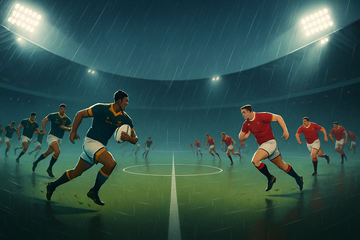
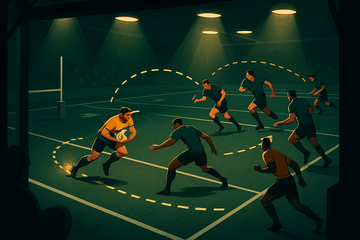
You see it when the All Blacks play in raining conditions. As halftime is ending, they are out of their warm changerooms five or ten minutes early, running figure of eights and passing the ball amongst themselves. Why? It allows them to adjust to the conditions before the actual game begins. When South Africa play in the rain the first time a player touches the ball is when he knocks it on at kickoff. It’s called problem solving. What amazes me about South African coaches is that they don’t just copy it, and do it when a Super Rugby team plays in some of the torrential Kiwi downpour.
Part of this New Zealand system is succession planning, both for players and coaches. They produced world-beating coaches as much as they do game-breakers. Players are nurtured into coaching, trained up on club rugby, promoted (if they have the talent and aptitude) to age groups sides at the provinces, up and up a ladder that equips the coaches with the skills and relevant experience in the same way a player is built up to be ready for playing in the torrents of tension and stress that is international rugby.
Before Allister Coetzee was appointed I told my poor Twitter followers that the only hope for Springbok rugby was to appoint a Kiwi coach. Look at what it has done for Wales (Warren Gatland), Ireland (Joe Schmidt), Scotland (Vern Cotter), Canada (Kieran Crowley), Fiji (John McKee) and even Georgia (Milton Haig). They all coached at last year's World Cup, which makes seven including New Zealand.
Gatland, who took over in Wales in November 2007, was the coach of the 2013 British and Irish Lions, who beat Australia 2-1 to win the series. The Waikato player then coach, will be in charge of next year's Lions tour to New Zealand.
I have changed my mind. What South Africa needs is New Zealand coaches starting at high school, and going up through the clubs, to provincial age-group and A team, into Super Rugby, and culminating at national level.
We need an overhaul of how we play, coach, and think rugby if South Africa has any hope of returning to its former glory as a behemoth of the world game – or another set of also-rans, a top tier rugby nation that is edging towards mediocrity and B-class status.
Just listen to New Zealand's attitude to its coaches, as New Zealand Rugby Union chief executive Steve Tew said last year: "If you don’t produce good coaches then you won’t produce good players. You need great coaches to produce great players. The coaches have to come first.”
“If you don’t have good coaching then you won’t have a successful sport, not long term. You might get away with it in the short term, but for long-term, sustained success you need a very good development programme and coaches, which we produce on a regular basis."
He adds: "You can have all the strategic plans in place, all the visions, all the structures, but if you don’t have the right people sitting in the right seats on the bus then the bus either doesn’t move or it eventually breaks down.”
In New Zealand they actually care about coaching. They recruit coaches from former players (which is a clever strategy for retaining experience that any business would boom from employing), train them, incentivise them, give them more training, make them better at their job. Previous All Blacks coaches are integrated into the system, or take up director of rugby roles where they can transfer some of their methods, skills, knowledge. They become elders with wisdom to pass on, mentors to train the next generation of coach.
In South Africa, coaching the Springboks is a poisoned chalice. All previous Bok coaches are sent to a special kind of purgatory where their collective knowledge can do no good whatsoever for their hapless successor. Every time a new Springbok coach arrives, it's virgin territory because the frustrated coach always leaves in bad terms after yet another failed World Cup attempt. Coetzee is going through what all the other coaches have experienced. Imagine how helpful it would be if he had back up? A bench of non-playing reserves to help when times got tough, as they have a lot quicker for Coetzee in his first year than anyone imagined.
Legendary coaches like Nick Mallett could inject so much wisdom and world experience into the mix if it wasn't the kiss of death to have ACTUALLY been the Springbok coach.
What is it with that? Why are former Springbok coaches sent to Coventry after they've done their job?
It's because of the administrators, that's why. The national best interests are torn apart by petty provincial interests and a startlingly short-sightedness that has kept a country with such enormous abundance of rugby-playing talent from being as good as we should be. The big picture is always having to fight the big egos of the little players whose provincial interests undermine the national ones at every turn.
Our players are professionals. Our coaches are professionals. Our administrators are rank amateurs. But that is another argument for another day.
What we need now is not just to play more like the All Blacks, but to be MORE like New Zealand rugby.
We need to train our players properly with the skills for this modern era. We need to transform coaching into the professional, honourable profession it is in New Zealand. We need to overcome our nostalgic belief that because we tend to be bigger and stronger than the other countries (except the Island nations) we're better.
We need a radical overhaul of the way rugby is coached and played. That is going to take what England have been willing to do by hiring Australian Eddie Jones: hire a foreign coach. As much as I wish Coetzee well and hope he can pull off a miracle, logic dictates that only an outsider, who is devoid of all the cultural baggage we South Africans suffer from, can kick-start a resurgence in our rugby.
* Rugby-mad Shapshak is editor-in-chief and publisher of Stuff (Stuff.co.za) but was sports editor of the Mail & Guardian twice. Follow him on Twitter: @shapshak