OPINION: Some of the officiating during the All Blacks' three-test series against France was frustrating to say the least.
It wasn't that the referees were getting decisions wrong, necessarily, but that the laws of rugby are so heavy on interpretation, or just plain stupid, that every call was up for debate.
Add to that the fact that World Rugby reserves the right to swoop in with their legal team and upturn a refereeing decision - even if, by the laws, it seemed sound - and things get murkier still.
As Steve Hansen said on Sunday: "It has got to a point where we have got to do something, because it is starting to affect the game."
'It's just ridiculous' - Steve Hansen fires shots at World Rugby’s leadership
The All Blacks coach said World Rugby needs to take action after controversial calls went against the Wallabies and the All Blacks.
changes and additions that should be implemented by World Rugby, the intention being to simplify some areas and make it easier for the fans to understand what on earth is going on?
LAW 6 (MATCH OFFICIALS)
Current law: If the ball or the ball-carrier touches the referee or other non-player and neither team gains an advantage, play continues. If either team gains an advantage in the field of play, a scrum is awarded to the team that last played the ball.
New Law: If the ball or any player touches the referee or other non-player and neither team gains an advantage, play continues. If either team gains an advantage in the field of play, a scrum is awarded to the team that last played the ball.
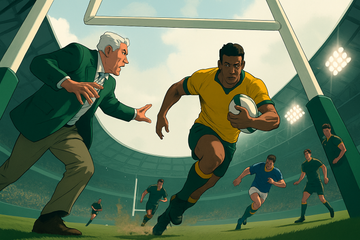
The reason Damian McKenzie was awarded his try by referee John Lacey on Saturday night in Dunedin was that he, as the ball carrier, never touched the referee. The fact that French halfback Baptiste Serin was impeded didn't matter, by the letter of the law. Rip that up and change it.
Current law: 16. Any of the match officials, including the TMO, may recommend a review by the TMO. The reviews will take place in accordance with the TMO protocol.
New law: 16. Any of the on-field match officials may recommend a review by the TMO. The reviews will take place in accordance with the TMO protocol.
There is too much TMO interference in rugby. Leave decision making on the field, and add a further law.
New law: 17. Each captain has one TMO referral, to be used to determine whether a try should or should not have been awarded. If a referral is successful, the captain retains his TMO referral.
Steve Hansen is right. Like the NFL, the teams should have the right to challenge a call. Keeping it on the field is good, so giving the referral to the captain to use, but it could be used by the coaches box instead.
LAW 9 (DANGEROUS PLAY)
By the laws, it seemed Benjamin Fall had to be red carded, only for World Rugby to quash the card.
Nothing needs to change with the laws themselves when it comes to dangerous play. They are straight-forward and make sense.
Where they get confusing is in regards to cards. To take some of the interpretation out of it, there should be guidelines as to when what card is awarded.
New law: A yellow card is awarded for an accidental act of dangerous foul play. This is when a player did not intentionally foul an opposition player. A red card is awarded for a deliberate act of dangerous foul play.
This is badly needed. If we go over some of the key calls from the past three weeks, these are the cards that would have been given under these laws.
Sam Cane and Ofa Tu'ungafasi would have been yellow carded. Both of them. They didn't intentionally tackle Remy Grosso high, so they both get yellow cards.
Finally, Israel Folau is yellow carded. His act was reckless, as he pulled his Irish counterpart down following a fair challenge for the ball. You wouldn't call it an intentional tug, as he was simply trying to make sure he himself fell safely. Had the player landed on his head, it should still be a yellow.
It wouldn't be a perfect law, but it would be an improvement. For reckless play in particular, it is always better to have a yellow card upgraded to red after the match, than the other way around.
LAW 21 (IN-GOAL)
Israel Folau of the Wallabies is shown a yellow card by referee Pascal Gauzere after pulling down an Irish opponent.
The current laws around grounding the ball need a little work.
Current law: The ball can be grounded in in-goal:
* By holding it and touching the ground with it; or
* By pressing down on it with a hand or hands, arm or arms, or the front of a players body from waist to neck.
New law: The ball can be grounded in in-goal:
* By holding it and touching the ground with it; or
* By pressing down on it with a hand or hands, arm or arms, or the front of a players body from waist to neck.
* A player must be deemed to have control of the ball to have grounded it.
All too often we have those moments where a fingertip is involved in the grounding of the ball. By the laws, having the very end of your pinky flick the ball when it comes into contact with the turf should be a try. Adding the "control" element makes it much clearer.
The referral system Hanson is talking about might be worth a try but in fact now captains tell the ref when the think something is illegal and it seems he checks in many cases when they do this.
Making sure the player has control of the ball to be awarded a try would stop this finger tip stuff.
The change related to the ref potentially being in the way sounds excessive as how many times does this happen? Plus some players may seek the ref out and then run into him. If this is proven to be a real problem than change the law otherwise leave it alone.
What do you lot have to say about changes? Beeno banning kiwis from rugby is not an option