The match was a tale of two halves, beginning as a competitive duel and ending in a rout. An under-strength Sharks team held the majority of possession in the first half but failed to capitalize, while the All Blacks, with less of the ball, still managed to score twice. Post-halftime, the All Blacks dominated, scoring four tries in quick succession, turning a tight game into a one-sided affair.
Jordie Barrett, who was pivotal in navigating the challenging conditions, underscored the importance of continuous improvement, reflective of a leader's mindset. "We've got to keep getting better as this tour goes on," Barrett stated after receiving the man-of-the-match award.
"We've got to keep getting better as this tour goes on."
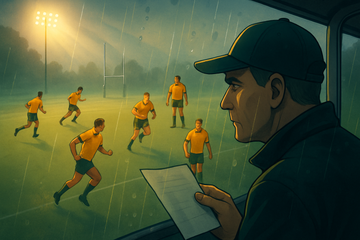
The conditions at Kings Park were less than ideal, turning the game into a quasi-aquatic spectacle. Continuous rainfall transformed the pitch into a pool, with every kick and tackle splashing water, challenging both teams to adapt their strategies. Damian McKenzie notably missed a sure try when he slid over the try line, losing grip of the ball in a critical moment.
The All Blacks adapted their game plan mid-match, shifting from tight plays to expansive, skillful maneuvers that utilized the waterlogged field to their advantage. This tactical pivot was highlighted by Ruben Love's precise long-range kicking and Quinn Tupaea's strategic offloads, which effectively set the stage for several of the All Blacks' tries in the second half.
Despite the unfavorable conditions, the All Blacks' goal-kicking was nearly flawless. Kicking seven out of eight attempted conversions in a downpour demonstrated exceptional skill and focus, especially considering the unstable footing and soaked ball.
The Sharks, while spirited, clearly felt the absence of their Springboks players, struggling to maintain pace with New Zealand's intensity as the game progressed. Their effort in the first half was notable, with several promising advances into All Blacks territory, yet they failed to convert pressure into points.
Defensively, the second half saw the Sharks overwhelmed, managing only 29 percent possession and making more tackles than their counterparts. Despite this, their lineout efficiency was a small victory, maintaining an 85 percent success rate against the All Blacks' 82 percent.
Reflecting on his team's performance, Sharks captain Nick Hatton acknowledged the challenges posed by the All Blacks' pace. "New Zealand wanted tempo, quick ball made them lethal, and slowing it down was our job," he analyzed post-match.
"New Zealand wanted tempo, quick ball made them lethal, and slowing it down was our job."
While the game ended in a comprehensive victory for the All Blacks, Jordie Barrett rightly noted the upcoming fixtures against the Springboks would be a different challenge entirely, underscoring that "Ellis Park will bear no resemblance to this."
The match also saw a poignant moment from Ma’a Nonu, who despite his team's overwhelming deficit, delivered a solo Haka in response to the All Blacks, a testament to his enduring spirit and cultural commitment.
In summary, while the All Blacks' victory over the Sharks was decisive, it was a game shaped as much by the relentless rain as by the players' adaptability and skill. Looking ahead, the true test will come against the Springboks, in conditions hopefully more conducive to traditional rugby.