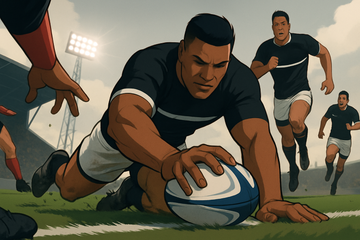
Despite underwhelming results in their aerial battles with South Africa during the Rugby's Greatest Rivalry series, the All Blacks, under the guidance of coach Dave Rennie, remain committed to their high-ball tactics. Rennie, who stepped in for Scott Robertson earlier this year, has markedly changed New Zealand’s style of play, prioritizing possession and a high-tempo attack.
Under the new rules from World Rugby established in 2024, which banned escorts, the All Blacks have adapted their approach, running back to catch high balls—a tactic that saw limited success against the robust Springboks. Nonetheless, Rennie confirmed the team's commitment to refining this strategy, citing its effectiveness in the Nations Championship matches in July.
“We’ve put a lot of emphasis around conditioning because we want to play a real high-tempo game and so we’ve tried to build that over time,” Rennie shared in a discussion with Newstalk ZB’s Jason Pine.
“Certainly when we were in South Africa, you get to the end of a seven-week campaign and you’re probably trying to pull back a little bit."
The team's focus has been broad, extending beyond just tactical adjustments. Rennie highlighted improvements in player conditioning and skill sets as crucial for executing their game plan, particularly when facing unique challenges such as those posed by the Springboks.
Addressing the nuances of the high-ball strategy, Rennie explained the difficulties posed by the shorter kicks used by the Springboks compared to the deeper kicks from other teams. He emphasized the need for the team to adapt to these challenges to maintain their competitive edge.
The selection criteria for the back-three players also reflect this strategic emphasis. Rennie pointed out that aerial ability, while important, is just one of several factors considered when choosing players for these positions. Players like Will Jordan, who have excelled in multiple roles across the field, are vital for their flexibility and skill diversity.
“We do a huge amount of work on it and people may question that, but it’s a part of a game, but it’s not the only part of the game. We’re picking outside backs for a number of reasons,” Rennie noted, highlighting the multifaceted approach to player selection.
However, the All Blacks face a significant setback with the loss of Ruben Love for the remainder of the international season, a blow to the team’s strategic execution. Amidst these challenges, Rennie called on World Rugby to consider simplifying the scrum laws to enhance the game's flow and understanding among fans.
In essence, while the high-ball strategy has faced criticism, the All Blacks' coaching staff remains confident in its potential. With ongoing adjustments and a focus on overall team dynamics, Rennie and his squad are poised to refine their techniques to meet the evolving demands of international rugby.