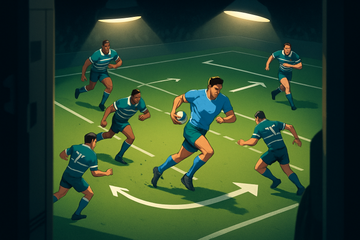
The NZ'ers are not only such wonderful rugby players and indisputably world champs but are the greatest GIVERS to rugby in the world...in that way they are the greatest contributors to the growth of the sport. Unlike England, Australia and South Africa who have shined on the world greatest stage the NZ'ers have gone the more than extra mile...they share rugby and have and are giving back teaching and coaching to the minnow nations...they love rugby as rugby and for the good of the sport, not selfishly but want to help others that play rugby without great support. When Russia qualified for RWC 2011, NZ rugby union had clinics in NZ for the Russian team players...I'm glad for this as I see it and in the very long term it will bring forth fruit. If you go eastern europe, Russia, Georgia, Ukraine, Poland etc...you will struggle to find rugby players (ask Dr Win) but when you find them , they are rugby fanatics and their mentors are the AB's...full stop. Not SA, Austr, France or Eng...thats for sure.
With 7's entering Olympics in Brazil next year...rugby will grow universally in leaps and bounds...7's will become popular with new comers to the sport...conservative rugby unionists (traditionists) will still stick to their support but gradually take interest and the spin off will permeate both ways...rather like cricket...5 day tests, 50 overs and 20 overs...I enjoy the lot but I'm a traditionist and favour the 5 day test but still enjoy the others.
For Mike, who also has interest in Russia this will interest him:
Rugby union in Russia From Wikipedia, the free encyclopedia Rugby union in Russia Russia U19 (in white) playing Georgia U19 in 2009. Country Russia Governing body Rugby Union of Russia National team Russia First played 1884, Moscow Registered players 21,670[1] Clubs 365 National competitions Rugby World Cup
Rugby World Cup Sevens
IRB Sevens World Series
European Nations Cup Club competitions Professional Rugby League
Rugby union in Russia is a growing sport. Russia is ranked 18th worldwide by the World Rugby,[2] having over three hundred clubs and close to 22,000 players nationally.[3] Russia has a professional domestic competition.
Contents
- 1 Governing body
- 2 History
- 3 Russian rugby terminology
- 4 Climate
- 5 Popularity
- 6 Competitions
- 7 International
- 8 National team
- 9 See also
- 10 External links
- 11 References
Governing body
The Rugby Union of Russia is the governing body for rugby union in Russia. It was founded in 1936 originally as the Rugby Union of the Soviet Union, and a specifically Russian body was set up in 1966. The Rugby Union of Russia became affiliated to the International Rugby Board in 1990.[4]
History
Pre-Revolutionary Russia
Rugby football in the Russian Empire pre-dated the Russian Revolution by a number of years, but it was only played sporadically. It appears to have been the first (non-indigenous) football code to be played in Russia, around a decade before the introduction of association football.[5] Mr Hopper, a Scotsman, who worked in Moscow arranged a match in the 1880s; the first soccer match was in 1892.[5] In 1886, however, the Russian police clamped down on rugby because they considered it "brutal, and liable to incite demonstrations and riots"[5] Condemnation by the tsar's police probably deterred many people from playing, and records of rugby over the next thirty years are sparse. Some rugby union was still being played in 1908, however the first "official" match took place in Moscow in 1923.
Soviet period
Main article: Rugby union in the Soviet UnionBecause of the Russian Revolution, some Soviet/Russian players emigrated and/or ended up playing for foreign sides, a notable example being Prince Alexander Obolensky (????????? ????????? ??????????) who played for Oxford and England in the 1930s - he was the scorer of 2 tries on his England debut in their win over New Zealand in January 1936. His noble birth precluded him from playing in his home country and his family had fled the country when he was only a year old.
In 1934 the Moscow Championship was started, and in 1936 the first Soviet Championship took place.
The game was more or less banned for a number of years in the Soviet Union because of an incident in a final in Moscow, when supporters of Llanelli and a Bucharest team were involved in a brawl.[4]
In 1949, rugby union was forbidden in the USSR during the "fight against the cosmopolitanism". The competitions were resumed in 1957, and the Soviet Championship in 1966. In 1975 the Soviet national team played their first match.[6]
Although there was the Soviet Cup and the Soviet Championship, rugby never became a major sport in the USSR. Union was the bigger of the two codes though - rugby league only really took off in the former Soviet Union after the collapse of Communism.
Post-Soviet Russia
When the Soviet Union broke up, there were two main consequences - firstly the loss of a much larger pool of players and fans, and secondly, the defection of many players to rugby league, which had previously been frowned on by the Soviet authorities. The two main areas for Russian rugby were to be Moscow and Siberia, and to a lesser extent, Leningrad/St Petersburg.[4]
The most notable Russian player perhaps is Dimitri Mironov who played for the Barbarians several times during the 1980s.[4] Vasily Artemyev currently plays for Northampton Saints in the English Premiership.
Russian rugby terminology
Russian language terminology for Rugby union positions
1 - ??????? ?????? ????? ???????? ??????? (Left Prop or Loosehead Prop)2 - ???????????? (?????) (Hooker)
3 - ??????? ?????? ????? ???????? ??????? (Right Prop or Tighthead Prop)
4 - ??????? ?????? ????? (2nd Row or Lock)
5 - ??????? ?????? ????? (2nd Row or Lock)
6 - ????? ????????? (Blindside Flanker)
8 - ??????????? (?????????)(Number 8)
7 - ?????? ????????? (Openside Flanker)
9 - ???????????? ??????? (???????)(Halfback or Scrum-half)
10 - ?????????? ???????????? (???????)(First Five-eight or Fly-half)
12 - ??????????? ?????????????? (Second Five-eight or Inside Centre)
13 - ??????????? ?????????????? (Center or Outside Centre)
11 - ????? ??????? ?????????????? (Left Wing)
14 - ?????? ??????? ?????????????? (?????????????)(Right Wing)
15 - ???????? (?????)(Fullback)
Climate
In 1978, Russia set the record for one of the coldest matches ever to be played, when Krasnoyarsk played Polyechika Alma at -23' C. Because Krasnoyarsk had travelled over 2,000 km to be there, the game was not called off. Instead, players resorted to wearing balaclavas, gloves, and several pairs of tracksuits to combat the cold.[7] Nonetheless, the extreme climate of Russia remains a problem, with winter sometimes being a split season, or the game of snow rugby being played.
Popularity
Although association football is the most popular spectator sport in Russia, rugby has been growing in terms of player base, spectator interest and media coverage in recent years. Rugby's rise into mainstream media happened a few years ago when the Heineken Cup, a club tournament in Europe, was given television coverage on the 7TV sports channel. 7TV also broadcast the 2003 Rugby World Cup. Subsequently, Russia's domestic championship, the Professional Rugby League, has earned weekly coverage on the RTR-Sport channel (a number of countries also receive this channel, such as Ukraine), though the games are not shown live. In addition to television coverage, rugby now features in mainstream news publications. In early 2006, RTR-Sport purchased the rights to cover the 2007 Rugby World Cup. In 2007 Moscow made an unsuccessful bid to host the 2009 Rugby World Cup Sevens. It was announced in February 2009 that the Rugby Union of Russia would again bid to host the Rugby World Cup Sevens, in 2013. After two other bidders (Brazil and Germany) withdrew, leaving Russia the only country with an active bid, Russia was officially named as host in May 2010.[8] Russia also hosted the IRB Junior World Rugby Trophy, the IRB's second-tier international competition for under-20 men's teams, in 2010.
Competitions
The main club competition in Russia is the Professional Rugby League, a fully professional competition. The competing clubs are VVA Saracens from ??nino in Moscow Oblast and Slava from Moscow, Enisei-STM and Krasny Yar both from Krasnoyarsk, RC Penza, RC Novokuznetsk, and Universitet from Chita Oblast. There also Top League and First League below the Professional Rugby League possessing a mixture of professional, semi-professional and amateur teams.
2013 Professional League teams
Club City Stadium Capacity VVA Saracens Monino Gagarin Air Force Academy stadium 5000 Yenisey-STM Krasnoyarsk Avangard 5000 Krasny Yar Krasnoyarsk Krasny Yar Stadium 3200 Slava Moscow Moscow Slava Stadium 2000 Spartak GM Moscow Moscow Rugby Academy Stadium ~1000 Fili Moscow Moscow Fili Stadium 2000 RC Novokuznetsk Novokuznetsk Rugby Stadium ~1000 Strela-Agro Kazan Kazan Tulpar Arena 3000 RC Bulava Taganrog Raduga Stadium ~1000 RC Kuban Krasnodar Trud Stadium ~10002013 Top League Teams
Club City Imperia Penza Penza Narva Zastava St Petersburg Dynamo-Energy Kazan RC Zelenograd Zelenograd VVA Academy Monino Enisey-STM Krasnoyarsk Krasnoyarsk Strela-Agro Kazan Kazan Maryino Moscow Zelenograd Moscow Moscow Mai Yuzhny Tushino Moscow Moscow Varyag Novgorod NovgorodLocations of Top 2 Tier Teams 2013
VVA Monino Yenisey-STM Krasny Yar Agrouniversitet Kazan Slava MoscowSpartak GM
Fili Moscow RC Novokuznetsk Imperia Penza Boulava Taganrog Imperia Penza Narva Zastava Dynamo-Energy RC Zelenograd Maryino Zelenograd Moscow Mai Yuzhny Tushino Moscow Varyag Novgorod Locations of the 2013 Professional Rugby League & Super League teams
National champions
Year Team Year Team Year Team 1992 Krasny Yar 2002 Yenisey-STM 2012 Yenisey-STM 1993 VVA-Podmoskovye 2003 VVA-Podmoskovye 2013 Krasny Yar 1994 Krasny Yar 2004 VVA-Podmoskovye 1995 Krasny Yar 2005 Yenisey-STM 1996 Krasny Yar 2006 VVA-Podmoskovye 1997 Krasny Yar 2007 VVA-Podmoskovye 1998 Krasny Yar 2008 VVA-Podmoskovye 1999 Yenisey-STM 2009 VVA-Podmoskovye 2000 Krasny Yar 2010 VVA-Podmoskovye 2001 Krasny Yar 2011 Yenisey-STMInternational
The Six Nations B, also known as the European Nations Cup (ENC) is similar to the Six Nations Championship. Russia finished third in the 2001 and 2001–02 competitions and second in the 2007–08 and 2008–10 competitions. Their second-place finish in 2008–10 also secured Russia's first appearance in the Rugby World Cup, which will take place in 2011 in New Zealand. The Nations Cup was introduced by the IRB in 2006, in which Russia and Portugal along with Argentina A and Italy A competed in Portugal.
Super Powers Cup
The Super Cup was an annual international rugby union competition contested by national teams from Canada, Japan, Romania and the United States. It was previously known as the Super Powers Cup.
The Super Powers Cup was first launched in 2003. It was planned that China, Japan, Russia and the United States would play each other once. However, because of the SARS outbreak the Chinese team were forced to withdraw. Russia won the inaugural competition, defeating the USA 30-21 in Krasnoyarsk, Russia.[9] For the 2004 competition Canada replaced China.
European Challenge Cup
In 2015 Russian club Yenisey-STM was included for the 2015-16 season of the European Challenge Cup. The first fixture was against Irish club Connacht at their home stadium. During the match temperatures got close to -20°c and the field was covered in ice. Yenisey-STM lost 14-31 against Connacht.
National team
Main article: Russia national rugby union team Russia playing GeorgiaRussia previously played as part of the USSR, and in the early 1990s, as a combined CIS team. Since 1992 however, they have been playing as Russia. The team qualified for its first Rugby World Cup by tying Romania 21-21.
Russia competes regularly in the European Nations Cup, and more recently, in the Nations Cup.
Russia succeeded in qualifying for the 2011 Rugby World Cup.
See also
- Russia national rugby union team
- USSR national rugby union team
- Rugby Union of Russia
- Professional Rugby League
- Rugby league in Russia
- Sport in Russia
- Marcel Burgun, France, born in St Petersburg.