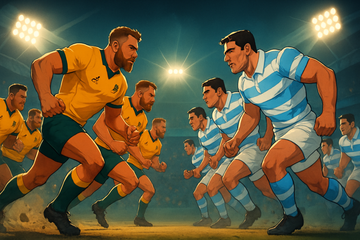
Argentina had a difficult pool of death and we know WC's are sudden death and they were burnt out as well as a bit unlucky with Tomas Lavanini's red card offence signing a death warrant for them...14 men against an English side that put NZ to rest. They were runners up in Supers against Saders in NZ too, a milestone that never happened before.
Ofcourse I don't know how the Sharks and Russian rugby union communicated but it certainly never happened before and one can only surmise World Rugby (ex IRB) must had something to do with it...the Sharks are not the only one's...there have been a few others. It's a very small issue and not the point...the point is things that never happened before are taking place and there's communication and interaction that's positive.
Yes, it is a very slow process but it's starting to bud and some fruit is showing...one can only conclude that some steps taken to achieve World Rugby's goal of promoting the game overall are in the right direction.
GOVERNANCE
Council
The World
Rugby Council meets twice a year and manages and controls the affairs of World
Rugby.[31]
The Council formulates and oversees the implementation of World Rugby's strategic
plan and application of policy decisions, and selects the host nation(s) for
the Rugby World Cup. The Council
considers recommendations of the General Assembly. The Council may admit or
expel member nations. The Council is also the supreme legislative authority of
World Rugby. Most Council decisions require approval of simple majority, but to
amend the World Rugby's by-laws, regulations, or the Laws of the Game requires
approval of three quarters of the Council.
Prior to
2016, the Council had 28 members. In November 2015, World Rugby announced that
they would be adding more unions to the voting council and giving the regional
associations two votes each on the council.[32][33]
As of
November 2018,[34]
the council is composed of 33 delegates with a total of 50 votes, allocated as
follows:[clarification needed]
- (30) Ten unions each have
three votes and two delegates: Argentina, Australia, England, France, Ireland, Italy, New Zealand, Scotland, South Africa, and Wales.[clarification needed]
- (2) One union has two votes
and one delegate: Japan.
- (6) Six unions each have one
vote and one delegate: Canada,
Georgia, Fiji, Samoa, Romania, and the United States.
- (12) The six regional
associations representing Europe,
South America, Americas North, Africa, Asia
and Oceania
each have two votes and one delegate.
In total,
Europe has 22 votes; Oceania 10 votes; South America 5 votes; Africa 5 votes;
North America 4 votes and Asia 4 votes.
A
Chairman and Vice Chairman are elected from among the delegates and these
positions are held by Bill
Beaumont of England and Agustín
Pichot of Argentina, respectively, as of May 2017.[34][35]
Funding
World
Rugby have recently[when?]
released £18.6 million of funding over three years for developing rugby
nations Canada, the USA, Japan, Romania, Fiji, Samoa and Tonga. Argentina will also receive
additional support to enable it to retain its tier one status. The money, built
up from successful World Cups, was released following a report commissioned by
World Rugby highlighting the growing disparity between tier one and tier two
nations. (see IRB
statement). This is in addition to the £10–12 million it normally
gives out grants and tournament costs. The emphasis is on three areas
infrastructure, high performance units and cross border competitions.
It was
announced in April 2006 that tier-3 rugby nations Georgia, Portugal, Tunisia and Russia were identified as the key
investment nations over the next three years. The program is designed to
increase the competitiveness of international rugby union.
IRB Statement 14 years ago...see link below
IRB