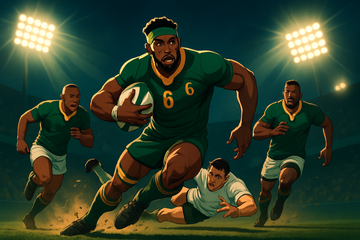
" To all three non-thinkers on site from News24:-
Just the third South African winner of the prestigious World
Rugby Player of the Year mantle … and first Springbok loose forward since
Schalk Burger back in 2004.
But
there could be few doubters anywhere over the crowning of Pieter-Steph
du Toit, the quintessentially modest, soft-spoken giant from
farming stock in the westerly regions of the Boland, for this year’s title just
a day after the Boks’ stunning RWC 2019 success.
It was a
serious SA “clean-up”, of course, with the national team unsurprisingly earning
Team of the Year, and their meteoric-rising, master tactician Rassie Erasmus
the Coach of the Year laurel for good measure - again, pretty much no-brainers.
The Player of the Year title was instituted by the former
International Rugby Board in 2001, and first won by feisty Irish hooker Keith
Wood.
As you
might expect, it has been significantly monopolised since by New Zealanders,
with as many as 10 recipients subsequently - including two three-time winners
in Richie McCaw (2006, 2009 and 2010) and Dan Carter (2005, 2012, 2015) and
back-to-back wins by Beauden Barrett in 2016 and 2017.
The Player of the Year title was instituted by the former
International Rugby Board in 2001, and first won by feisty Irish hooker Keith
Wood.
As you
might expect, it has been significantly monopolised since by New Zealanders,
with as many as 10 recipients subsequently - including two three-time winners
in Richie McCaw (2006, 2009 and 2010) and Dan Carter (2005, 2012, 2015) and
back-to-back wins by Beauden Barrett in 2016 and 2017.
It was initially a tough, hardly flawless swap for Du Toit, who
has commendably, gradually also shed a few of his previous 120 kilograms to
cater specifically for the different needs (including key positioning awareness
on defence) of the side-of-scrum berth: remember the awkward, costly run-around
he got defensively from a devilish, dummying England scrumhalf Ben Youngs in a
Test at Twickenham in late 2016?
In the
higher-tier RWC 2019 showpiece, Youngs was again England’s starting No 9 ...
but the brutal pressure an altogether more street-wise Du Toit placed on both
him and jittery halfback partner George Ford somehow symbolised the
ever-mounting triumph of his conversion.
The Boks
have prided themselves for decades in big, brawny, yet skilled and mobile
blindside flanks who are effectively “extra locks” on the park for the levels
of general grunt they offer but also as strong back-of-lineout jumpers,
forceful cleaners and durable tacklers.
Theuns
Stofberg, Gert Smal, Danie Rossouw, Juan Smith ... they are just some notable
examples of what has gone before in the No 7 jersey since the 1980s.
The rangy Smith, of course, was a key pillar of the Boks’ last
World Cup triumph in France in 2007: Du Toit was to prove every bit as dynamic
and industrious - and perhaps even then some - over the course of several weeks
in Japan and also in the lead-up Tests of the current, glittering calendar
year.
He is as
comfortable and high-worth now as he could possibly be at No 7, presumably
still with several seasons of yeoman service to come (touch wood, for a player
who also had two serious cruciate knee ligament injuries to wrestle with
earlier in his first-class career, the blond bomber has also been blessed by
uninterrupted clean health on that front for a long time since).
In many
ways, Du Toit - always willing and engaging enough, yet so clearly not hugely
comfortable in the glare of media flashbulbs - provided an array of obvious
strengths at blindside flank that other frontline countries in Japan tellingly
could not.
At least
partly motivated by not having quite the level of orthodox class and range of
attributes they might wish to sport in the blind-sider berth, teams like New
Zealand, England and Australia have tended to lean recently toward a “two-fetcher”,
lower-centre-of-gravity policy for their flankers.
That is
fine on a day where manufacturing turnovers at vital times is a common
hallmark, but Du Toit proved quite categorically on Saturday that - especially
when you are looking after your own ball zealously, as the Boks overwhelmingly
did - there is no substitute for a charging, marauding, tall-timber behemoth
routinely knocking people back and ensuring front-foot momentum on a regular
basis.
Just one
reason the formerly imperious All Blacks have taken a costly step backwards in
the last year or two, I am adamant, has been the failure to properly identify a
viable, robust blindside flank to succeed Jerome Kaino, who quit internationals
after 81 caps in 2017.
South
Africa? Well, simply no such angst these days."