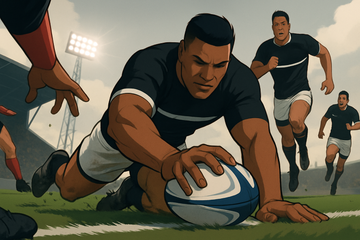
WORLD CUP FINAL: THIS IS IT - THE CLIMAX OF FOUR YEARS OF SWEAT AND TEARS, OF PLANNING, OF SPECULATION AND HOPE. PAUL DOBSON PREVIEWS THE MATCH.
It is the distillation of those four years, the denouement when all the players are brought together in one room to reveal the truth - who will receive the Webb Ellis Cup and shoot in golden ecstasy into the night sky to wear the crown of World Champions for the next four years.
It is the eighth Final and the first one in which these competitive neighbours will do battle against each other in a Final.
Just the nature of their proximity and rivalry is bound to produce a final of grievous intensity.
The skills of both teams are likely to produce an all-action, 80-minute Final, perhaps the best to crown this best of all Rugby World Cups.
Hosts England have turned on the best for their guests.
The stadiums have been so well cared for and filled with cheerful people. So will Twickenham be on Saturday - manicured and packed out with 82 000 spectators in great mood and voice.
Sweet Chariot won't be there, nor Bread of Heaven, nor Athenry nor Flower of Scotland, but there will be noise and, bless the hosts, despite the absence of their team there has been no sulking but only cheerful, well-mannered happiness.
There will be 82 0000 in the stadium and millions elsewhere watching it with rapt attention, even though it is the middle of the night in the Antipodes.
The end of the 2015 World Cup will see the top four teams in action - third versus fourth for third place and one versus two for glory and massive rewards in satisfaction, kudos and kind.
One thing is for sure - that both sides will give every bit of themselves in search of victory. There will be no shirking, no lapse of concentration - nothing but a complete effort of mind and body from every player and each team.
There is enough of a competitive spirit between the two to flow over onto Twickenham.
Australia likes to be bigger and better at so many things, sometimes referring to New Zealand as a suburb of Sydney.
But big Australia cannot match little New Zealand's passion and success. After all rugby is the main team sport in New Zealand, in some ways the country's greatest cultural achievement, whereas in Australia Rugby Union comes fourth in winter sports - behind Aussie Rules, Rugby League and soccer.
Both teams can attack cleverly and at speed and both can score glorious tries. Both teams have excellent defences. Australia showed it especially in dealing with the newly creative Pumas while the All Blacks kept the Springboks a long way from scoring a try in their semifinal.
Both teams have conceded a similar number of penalties - an average of 10 per match though they were both penalised heavily in the semifinals - Australia 12 times and New Zealand 13 times - twice as many times as their opponents.
The battle for first phase ball will be interesting and here New Zealand may just have the edge, especially with Kieran Read's clever line-out jumping.
But the battle for the breakdown ball could be crucial and the contest between David Pocock and Michael Hooper and Richie McCaw and his helpful mates, who include brave Conrad Smith, may well provide the key to victory.
In their six matches each at the World Cup so far, the Wallabies had won 42 turnovers, the All Blacks 45.
Players to Watch
For Australia: Will Israel Folau's ankle let him play his unique game? But you would certainly want to see the bravery and strength of David Pocock in action.
For New Zealand: Will Kieran Read get back to full form? The sight of Julian Savea rumbling down the left wing and Ben Smith skating all over the field is worth the entry ticket.
Head-to-Head: There is the clash of the front rows where New Zealand believe they could dominate Australia even though they have not been so wonderful themselves and Mario Ledesma's scrum coaching has greatly improved the Wallabies. Then there are individual contests of note. Old bull Richie McCaw against young bull David Pocock at the breakdown. Lively Aaron Smith against wise and steady Will Genia. Experienced Dan Carter at flyhalf against enthusiastic Bernard Foley, both excellent players, Carter one of the all-time greats of the game. Clever, strong Matt Giteau against Ma'a Nonu whose strength has often hidden his skill. The four superb wings - Adam Ashley Cooper and Drew Mitchell against Julian Savea and deceptive Nehe Milner-Skudder. Kicking means points and it means acres. That is largely a contest between the flyhalves - Dan Carter of New Zealand and Bernard Foley of Australia. Both are capable of the outstanding kick at goal. Foley has scored 75 points at the World Cup, Carter 63. When it comes to kicking out of hand, Carter seems to have the edge in variety and telling effect. Both teams kick well - mostly to retrieve rather than mindless hoofing downfield. Those are just some contests because actually the head-to-head is All Blacks against Wallabies.
World Cups
They have in fact met three times in World Cups, each time in a semifinal and, oddly, Australia lead 2-1, winning in Dublin in 1991 and in Sydney in 2003 but losing in Auckland in 2011. Both teams have similar World Cup experiences. They have each played three times in finals, each winning twice and each losing once. New Zealand won finals on both occasions that it was played in New Zealand - 1987 and 2011. Both of Australia's victories were away from home and their defeat in a final was at home. Both have lost finals that went into extra time - New Zealand in 1995 and Australia in 2003. This means that the winner on Saturday will become the first team to win the World Cup three times. Should that be New Zealand, they will then become the first team to win it back-to-back. Should Australia win it they would preserve their record of winning away finals. It is hard to equate their results at this World Cup as they were in pools with differing demands. New Zealand were in a pool with Argentina, Georgia, Tonga and Namibia while Australia were in that frightening pool - with England, Wales, Fiji and Uruguay.
Prediction: History suggests a New Zealand victory, but the World Cup has a better history for Australia - not that the outcome on Saturday will be determined by history. At this World Cup, New Zealand have not been as close to defeat as Australia were against Scotland. Their defeat of the Springboks was much larger than the two-point difference suggests. There is a strong suspicion that, as at Cana of Galilee, they are saving the best for last and will beat the Wallabies by about eight points. But - beware. It is a Final. In New Zealand in 2011 the All Blacks were overwhelming favourites against France and in the end won 8-7 and were not convincing in doing so.
The teams:
Australia: 15 Israel Folau, 14 Adam Ashley-Cooper, 13 Tevita Kuridrani, 12 Matt Giteau, 11 Drew Mitchell, 10 Bernard Foley, 9 Will Genia, 8 David Pocock, 7 Michael Hooper, 6 Scott Fardy, 5 Rob Simmons, 4 Kane Douglas, 3 Sekope Kepu, 2 Stephen Moore (captain), 1 Scott Sio.
Replacements: 16 Tatafu Polota-Nau, 17 James Slipper, 18 Greg Holmes, 19 Dean Mumm, 20 Ben McCalman, 21 Nick Phipps, 22 Matt Toomua, 23 Kurtley Beale.
New Zealand: 15 Ben Smith, 14 Nehe Milner-Skudder, 13 Conrad Smith, 12 Ma'a Nonu, 11 Julian Savea, 10 Daniel Carter, 9 Aaron Smith, 8 Kieran Read, 7 Richie McCaw (captain), 6 Jerome Kaino, 5 Samuel Whitelock, 4 Brodie Retallick, 3 Owen Franks, 2 Dane Coles, 1 Joe Moody.
Replacements: 16 Keven Mealamu, 17 Ben Franks, 18 Charlie Faumuina, 19 Victor Vito, 20 Sam Cane, 21 Tawera Kerr-Barlow, 22 Beauden Barrett, 23 Sonny Bill Williams.
Date: Saturday, October 31
Venue: Twickenham, London
Kick-off: 16.00 (16.00 GMT; 05.00 Sunday, November 1 New Zealand Time; 03.00 Sunday, November 1 AEDT)
Expected weather conditions: Clear with no rain forecast, a high of 19°C and a low of 8°C - good autumn day for rugby though the field may be slightly affected by two days of light rain before Saturday.
Referee: Nigel Owens (Wales)
Assistant referees: Jérôme Garcès (France), Wayne Barnes (England)
TMO: Shaun Veldsman (South Africa)
By Paul Dobson