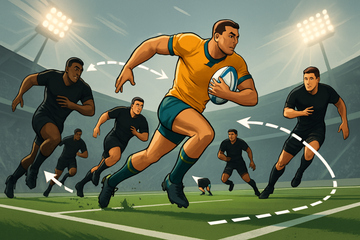
Which rugby positions are being changed by the people playing the game currently?
One of the fascinating things about watching sport is the way it changes over time. This can be due to of the talent in the game at any time.
Throughout the last seven or eight years LeBron James helped basketball evolve due to the way he could adapt his skill set to almost any position on the court depending on the opponent’s strength or weaknesses. Last year and this year the likes of Steph Curry, Klay Thompson at Golden State, as well as the San Antonio Spurs have confirmed the game’s next evolution – one that emphasises ball movement above individual strengths and finding space to take three point shots.
In the shorter forms of cricket you could sense while Adam Gilchrist played that the expectations on a wicket keeper would never be the same. Now, especially in the shorter forms of the game, they are expected to be a seventh batsman, and maybe an opener.
In previous generations whatever effort the keeper managed with the bat was a bonus, not a prerequisite. Gilly changed all that.
Triangles, sweet beautiful triangles, have overtaken the game of football at the highest levels. To the point where the viability of an old fashioned striker at the very top level is in question. Gone are the days where you could devote a position on the pitch solely to poaching goals inside the box, pressing on the last man and trying to get his head on the long ball.
Now all 10 outfield players must be at home all over the pitch as the team compresses, expand, shift and adapt on the fly. False nines are the new black.
Those who follow the NFL will be able to wax lyrical about the running quarterbacks, the tight ends that might be a wide receiver and the hybrid outside linebackers and defensive end players showing great dexterity that have all emerged in recent years.
So what positions are evolving and have evolved on the rugby field in recent years. I’m going to put forward two position groups that have changed significantly and continue to change. Let me know if you can see it too, and nominate ones you think I’ve overlooked.
Back row
I group all of the backrow positions together because I think this is the place on the field increased athleticism, partly due to two decades of professionalism probably, has shown up the most in rugby.
The way rugby union is played now the back row positions are blending together and might be predominantly determined based on size, rather than skill set or tactical deployment alone. The player to watch in this regard is Richie McCaw. Sure, years and age may have slowed him down, but his move to spend more time at eight or even blindside flanker in recent years is partly down to the way the game is played.
A Crusaders backrow of Richie McCaw, Matt Todd and Keiran Read is a less partitioned skill set than you’d have found 10 years ago.
In 2015 a number eight’s defining trait is they expected to play with such ferocity and physicality it borders on a psychotic position to consider playing. Even just a few years ago the eightman was usually just big – think Owen Finegan, or even Pierre Spies more recently. Now you have to not only be big you have to play like Duane Vermuelen.
Seriously, the way he played against the Hurricanes on the weekend was manic. He is large, yes, but he throws himself, rams himself, jams himself and throttles himself until the opposition submit. The eightman must become a battering ram. Vermuelen has set a new high-water mark this year in my opinion and Jerome Kaino is the man who keeps lifting it higher with him.
I genuinely enjoy watching Keiran Read play but he is not the normal number eight anymore. His cerebral, athletic play needs to be balanced out by battering rams across the park. The same goes for Scott Higginbotham, who is a less-refined and (gulp) less-skilled Read.
Outright poachers at the openside flanker position are rarer because fitter teams in general mean everyone is expected to arrive at rucks sooner. Sevens have retained some of their freelancer role but I think the position is rugby’s x-factor one now.
You have the likes of Michael Hooper who is an all round athletic freak, Schalk Burger who is the new George Smith in the backline ball runner, Liam Gill who focuses on poaching but behaves like a modern version of John Eales with his lineout jumping and underrated dexterity and the Matt Todd/David Pocock types who still poach but act like powerful boulders around the park in rucks and tackles.
The opensider flanker is the position to experiment with pure athletes.
The blindside flanker position is a powerful blend of both the seven and eight. These players are usually such a good athlete they can combine the diesel engine of a second row with the power of a number eight. Playing back row positions in rugby has never been for the faint hearted, but in 2015 it’s at a new level.
Wing
Jonah Lomu’s playing weight was 119 kilograms and he was over 1.9 metres tall. He is still a benchmark for rugby wingers, but his dimensions are less and less of an outlier now.
Taqele Naiyaravoro is 125kg and 1.9 metres tall. Julian Savea is ‘only’ 108kg but is 1.93 metres tall and his 100 metre time can’t be too far off Lomu’s 10.8 seconds at his fastest. Nemani Nadolo is meant to be around 130kgs (I think he’s probably lighter now) and 1.95 metres tall. Frank Halai is 105 kilos and 1.95 metres. Patrick Osborne is 1.89 metres tall and 108 kilos.
The wing position in rugby has been changed forever, with a much more superhuman blend of size and speed becoming more normal. The professional game is rewarding physical freaks for their ability to both finish tries in space as well as bowl people over in traffic. One aspect of game-wide improvements in physical fitness and team organisation has been defence. To combat this, teams need attacking weapons that can run around teams and through them – not just one or the other.
If you’re willing to expand the position to include some fullbacks Israel Folau (1.93m/102kg) and Charles Piutau (1.86m/94kg), then you’d realise that the men at the back are hardly shrinking violets either.
The wing position is no longer a place to stick the skinny quicker guy. Those guys will get drilled in a tackle or run over by a flying Nadolo.
There is room for a few skill-focused wing players, such as James O’Connor, Willie Le Roux or Ben Smith. But having two wings with that skill set is now rare, and a good team will probably never have three of them in the back three ever again.
Pace and power on the edges – now the norm in rugby union.